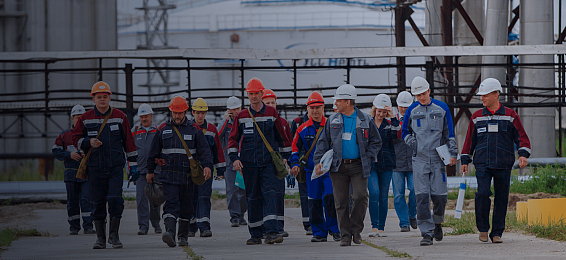

OAO Ulyanovskneft employees held the class dedicated to oil in Gymnasium No. 1
The 10th year students learned how the oil is discovered and produced. Ulyanovsk. New school year has started and it means that time has come to continue the “Classes with Komsomolka”.
Before the Day of Oil and Gas Industry Workers we visited to Gymnasium No.1 where Nikolay Kazakov (Head of Geology and Subsoil License Department) and Vladimir Moiseyev (Deputy Head of Technological Department of Oil Production, OAO Ulyanovskneft employees held a special geography class for the 10th year students with physical and mathematical special education. They did not make assessment but made an exciting and detailed story about oil. That’s what the students learned about the black gold.
BACK TO CHEMISTRY
Oil is a natural, flammable, oily fluid with specific smell. It is originated together with hydrocarbon gases usually at the depth of 1.2-2 km. Within chemistry oil is a mix of different hydrocarbons, organic compounds.
The molecules of the compounds consist of carbon and hydrogen atoms and represent simple, branched chain or closed chains. Apart from hydrocarbons oil may include other chemical elements – oxygen, sulfur and nitrogen.
Oil has different color (from light brown, with almost no color to dark brown, almost black). It also has different density, from light (0.65 – 0.70 g/cm3) to heavy (0.98-1.05 g/cm3). Apart from that lacquers, paints, plastic and cosmetics and synthetic fabrics are the oil products. Even the chewing gum consists of hydrocarbons.
Reservoir depth
Some scientists suggest that the oilfields should be called the place of accumulation. Oil deposits are originated in the places where oil comes into a trap after a long subsoil journey. First of all it is collected in the mountainous rocks (sands, sandstones, fractured limestone). These are the so called collectors which can absorb oil and give it away. Together with that there are cap-rocks. They are impermeable for oil and gas and lay above the reservoirs thus preventing the leak of the reserves.
Without these caps the oil would penetrate into rivers and seas and vaporize. Clay, mineral salt and other rocks can be used as caps. But their existence is not enough. The impermeable deposit should have a special form so that the oil is really trapped, then the real oilfield.
Anticline usually becomes this trap it has an arched form similar to the dome, closure or the so-called fault seal, intensive rock fracture. It serves as a barrier for the oil and the oil makes a subsoil lake.
WHERE AND HOW OIL IS DISCOVERED
The works for exploration and of oilfields include several stages.
At first a geological survey of location is done. The specialists arrive in the surveyed area where they study within the field works the deposits of the mountainous rocks, coming out to the surface, their structure and incidence angle. Mouse holes are made to analyze the source rocks, vertical mine workings performed for exploration of mineral resources. In order to get the idea of deeper deposits coring wells are drilled at the deep of 600 meters with which formation sampling is done. In result of processing geological maps as well as geological profiles are made.
After that the oil and gas zones are studied more carefully with a range of methods applied. Seismic is a priority which allows to study deep subsoil resources. This survey method is based on the laws of artificial elastic waves propagation in the crust.
The speed of propagation of the seismic waves varies in different rocks. The denser the rock is, the faster the waves penetrate through it. On the border of division of two mediums, elastic vibrations partially reflect returning to the soil surface, after partial refraction they continue to move into the subsoil deep to the new surface of the interface. The refracted seismic waves are fixed by the seismographs.
After that the specialists process the curve charts of epeirogenetic movement, the occurrence depth of formations which refractured the waves and their incident angle.
The second stage includes drilling of the wells for discovery of the wells. First exploration wells for studying sediment rocks mass are drilled as a rule at the maximum depth point. In course of drilling of the well and after reaching the depth point geophysical surveys in the wellbore are performed. The surveys are made with run-in-hole instruments on a special cable. This equipment has different physical principals, induced potential logging, induction, resistance test, gamma rays, neutron rays, caliper logging, etc.
According to the data received with this survey and its processing the geophysics remark depth range with net oil pay formation (reservoir beds). These objects are additionally discussed with the oilfield geologists, after that they make a communal decision on casing string run-in-hole operation for the test.
Well testing is a very responsible moment in well construction process. In case of industrial oil flow from the facilities which were already tested the oil reserves are estimated and entered on the state balance sheet for hydrocarbon production (oil, gas or gas condensate).
OIL PRODUCTION
Various types of drilling units are used in modern oil production. Some of them are 20 storey high, others have wheels, the third ones are standing at the platforms under in the open sea, for underwater drilling.
The aim of these units is drilling, it is better to say well construction – cylindryc mine pit with wellbore length much larger than its diameter. The upper part of the well is called wellhead. Walls of the well are called wellbore.
At first the hole of a wide diameter around 30 meters deep is drilled. After that the metal pipe with 324 diameter is run into the hole which is called the conductor. Then the cementing between the walls of the pipe and the walls of formation.
The conductor is needed so that the surface is not eroded or devolved at further drilling. After that the drilling of the with smaller diameter continues up to the depth of 500 to 800 m. Another 168 m casing is run in the hole again and the space between the pipes and formation walls is cemented at the whole length. This is conductor. Then the drilling is resumed and the well is drilled at the depth point. The 146 mm casing is run in the hole again; it is called the casing string. The space between the pipe walls and formation is cemented from the well bottom up to the wellhead.
Wellbore cementing is done by run in hole of special tubing. A range of tubing connected consecutively between themselves make up a casing string.
The wells can be drilled with mechanical methods, thermal and electric impulse methods and other methods (several dozens). Although only mechanical drilling can be applied in the industry – percussion drilling and rotary drilling. The rig can be rotated with the bottom hole motor or by rotating the casing string from the wellhead. Various types of wells are drilled depending upon the geological conditions of the oilfield: vertical (the angle of decline of wellbore from the vertical line does not exceed 5°); directed well (the angle of decline exceeds 5°); horizontal (the angle of decline of wellbore from the vertical line amounts to 80-90°); multilateral well, multibranch well (it has one main hole and one or several additional).
The oil is under pressure of the upper beds in formation while the pressure is lower from at the side of the well. Thus depression is created allowing the oil to move towards the well. In case the pressure is very high the oil enters the well and it blows to the surface. This is an open flow oil production method.
As the formation pressure falls, the pumps are used to extract oil. They create additional pressure so that oil in the well can go to the surface.
At the moment several types of pumps are used in dependence of the occurrence depth its viscosity and some other factors, among them sucker rod pumps, ESPs and positive cavity pumps (PCPs). OAO Ulyanovskneft is the only company in NK RussNeft which uses PCPs. Their peculiarity is to produce the oil which is difficult to recover, high-density oil which characteristic of the fields of Ulyanovsk region.
The top of the beam pump moves up and down which sets the pump rods into motion. The rods are connected to the pump which is cylinder and a plunger. When it goes up (the intake valve opens and the oil gets into the pump unit), while when it goes down the plunger lowers (the upper pressure valve opens the oil is injected into the pipe string above the pump unit). This is how the fluid goes slowly up. ESP is a submersible pump which sets in motion the electrical engine submersed in the well.
The pump injects the fluid from the impeller into guide apparatus with the centrifugal effort which is created by the motion of rotary with the impellers.
Flow area of the working units shall define the pump unit capacity, the quantity of the working units shall define the flow. PCPs are used to recover higher density pumps. PCP is a steel spiral rotor moved at the elastic stator. The stator is an internal spiral with elastic element. The rotor has one start more than the stator. When the rotor moves the pots constantly close and open as well as they move from intake to pump delivery.
WHAT HAPPENS TO THE ALREADY PRODUCED OIL
The oil from the well goes up to the surface into the pipelines. Through the pipelines it gets then to measuring unit where the quantity of oil is measured. Then the oil gets into units which separate APG, water and foreign solids are separated from it. Clean and treated oil goes to trunk pipelines of Transneft and then it goes to oil processing plants. Associated water is injected back to the reservoir to raise the pressure in it and to make further production of oil easier. APG is used as energy producing material to heat the oil fluid.
PAST AND PRESENT OF OIL PRODUCTION IN ULYANOVSK
Geological surveys in Ulyanovsk region started at the beginning of the 20th century. Southern district of the region were the most attractive. Oil exploration started in 1944 and 5 years later, in 1949, the first industrial flow was discovered in Nikolayevsky district at Baranovskoye field. Then the first fields of Ulyanovsk were discovered in a short period of time: Novospasskoye, Gologyaevskoye, Varvarovskoye, Novotomyshevskoye, Repyevskoye and Slavkinskoye.
Though the history of oil producing industry in Ulyanovsk region starts from 1977 where executive committee of Ulyanovsk regional Deputy Council in the working area Novospasskoye made a resolution to open the first oil and gas company Novospasskneft transformed into OAO Ulyanovskneft in 2001.
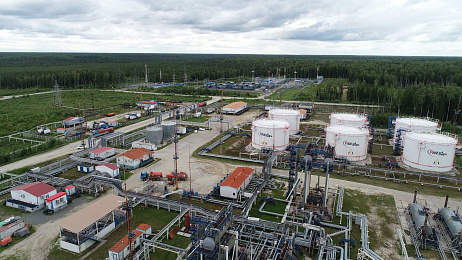
Today Ulyanovskneft OAO NK RussNeft the subsidiary of is the largest subsoil user in Ulyanovsk region. The company develops 39 fields in Ulyanovsk and Penza region. At the moment all the fields developed by the company are divided into 2 groups: Southern and Nothern. Fields of the Nothern group are located in North-East of Ulyanovsk in Melekessky, Cherdalinsky, Novomalykinsky districts. The Southern Group fields are located in the south of Ulyanovsk region in Novopassky, Nikolayevsky districts as well as in Penza region in Kuznetsky and Kameshkirsky districts.
The oil supply of the Ulyanovskneft fields makes up above 50 years.
CAN YOU BECOME AN OILMAN?
One can get education related to exploration, production and processing in Ulyanovsk state university at the Faculty of Engineering, Physics and High Technology or in Gubkin State University of Oil and Gas. OAO Ulyanovskneft will participate in implementing the joint education project of RussNeft and Gubkin State University of Oil and Gas. Within this project the children of the employees of the subsidiaries have a special course in regional preparing divisions opened on the basis of subsidiaries of OAO NK RussNeft in Saratov and Raduzhny. Specially developed programs involve 2 visiting sessions and serious individual work under patronage of the tutors of Russian State University. The main target of the preparing divisions is to effectively prepare the children for the State Exam and further matriculation to Gubkin State University. In course of implementing the project (since 2010) 16 Ulyanovsk graduates became the students of Gubkin State University.