
MORE THAN A POET
A poet, a musician, a decathlonist, a philanthropist, a banker, an industrialist and an oilman – all that is about charismatic and energetic 57-years old billionaire Gutseriev, who practices and succeeds in whatever he shows an interest in.
The number of those who are not satisfied with the governmental fiscal policy is getting bigger. In autumn the entrepreneurs wrote a letter to the Russian President, asking not to raise MET (the head of Gazpromneft Alexander Dukov was among them, see the details in «К°» N 866 (38) from 19.10.15, “The Duke of Arctic”). Tax was left unaltered, however the export duty was frozen at the level of 42 % (initially the duty was supposed to be reduced to 36%). As estimated by Minister of Energy Alexander Novak, this measure brings 133 billion rubles into the 2016 budget, meaning that the Government and oil industry tied the score. Especially taking into account the fact that the Minister of Finance Anton Siluanov expected to earn 609 billion rubles having increased MET.
“After one year – no more Tatneft, after another year – no more RussNeft, each year - minus 15-20 million tons of crude oil,” predicted Gutseriev, describing the situation in the industry if the oil price is maintained at lower than 50$ with tightening the tax policy.
Senior analyst of Arbat Capital`s Oil and Gas sector Vitaly Gromadin believes that the market is not interested in small and medium-sized companies.
“For them (smaller companies) it has become even harder to survive in the shadows of corporate giants,” he says and explains that such companies get access only to the hard-to-recover reserves. “If the Government provides support, there will hope for survival. However, the probability of this looks currently very small,” comments Gromadin.
It must be said, there is no so much ground for worry for Mikhail Gutseriev. He is not only the owner of RussNeft. The billionaire has his interest in coal, construction, financial industries. He even contributes to the entertainment market. For the short period of Medvedev`s presidency, the Russians realized that economy desperately needed diversification. The authorities didn`t succeed in that yet, but Gutseriev did master the lesson. Even if the whole industry collapses, Gutseriev will be able to earn money in completely different fields. But RussNeft is a crown jewel of his assets. According to his own estimate, it will cost $18 billion in 2016 (in 2014 prices, when dollar cost 34 rubles). Nevertheless it is not the price, but the model of the company that matters. This company is a second tier company. Taking into consideration the high-concentrated nature of the market, when it is divided between giant corporations, RussNeft has to play on a foreign field by foreign rules.
“The Company conducts consisted policy of assets consolidation, constructing the vertically integrated entity,” said Mikhail Tovmasyan, the head of the practical projects The Infrastructure of consulting Group NEO Tsentr. The expert continues that taking into account resource potential, reserves availability and development prospects, the most attractive assets would be the following: OAO NAK Aki-Otyr, OOO Beliye Nochi, OAO Saratovneftegaz, OAO Aganneftegazgeologia, OAO Varioganneft. The chief analyst of Promsvyazbank Ekaterina Krylova also considers NAK Aki-Otyr as one of the most attractive asset of RussNeft. The company was incorporated into Gutseriev`s empire in 2005. “In the end of 2014 NAK Aki-Otyr acquired 100% of ZAO Khanty-Mansiyskaya Neftyanaya Companiya. Both assets provided an opportunity to conduct operations in KhMAO, with total production output of 2 million tons per year, or 12% of the total RussNeft production,” comments Krylova.
By the year 2006 RussNeft became an international company, which, unfortunately, had limited opportunities for expansion, so it did not distance itself from the Motherland. The State Oil Company of Azerbaijan (SOCAR) and RussNeft agreed to develop jointly the oilfield Zykh-Govsany (small area with estimated reserves of 12 million tons). In that same year Orsk Refinery was modified, resulted in 30% increase in capacity.
It seemed that RussNeft was going through usual business process - growing, raising its market share, spending money on infrastructure development and necessary assets acquisition. However, that moment was a turning point as Gutseriev and his company attracted the attention of Deputy Head of the President of Russia Administration, a Chaiman of the Board of Rosneft Igor Sechin and the officials of the military and security complex.
The businessman managed to become a Member of the Lower Chamber of the Russian Federal Assembly – the State Duma (first he was elected from LDPR, then as a deputy from a single-seat constituency), and later the Deputy Chairman of the State Duma. He supervised the issues related to North Caucasus affairs. Simultaneously he continued his education and graduated from Gubkin State Oil and Gas University (engineer, majoring in Methods and Technology of Oil and Gas Engineering), followed by the Finance Academy under the Government of the RF (majoring in Finance and Credits) and St. Petersburg University of Law (having received PhD degree in Criminal Procedural Law). He also accomplished Doctoral studies at the Plekhanov Russian University of Economics (majoring in Free Economic Zones). During the mid-90s and early 2000s was the time when Gutseriev`s activities reached their heights. Sometimes it seemed that no single man was able to accomplish so many deeds. For example, in 2001 he was elected to the Russian Academy of Natural Sciences (shortened to RANS), which, however, is not as highly ranked as Russian Academy of Science. The latter, personified by astronomer Yuri Efremov and physicist Vitaly Ginzburg, often criticize RANS for enrolling some quite odd people in their register. Let`s remember Victor Petrik, who invented water filters, which didn`t filter anything (their packages contained proud inscription ”The project “Clean Water” of the United Russia political party”. Those filters were named “Shoigu” after the former Minister of Extraordinary Situations). Let`s also remember the astrologist (not astronomer) Grigory Kvasha and the savior Grigory Grabovoy, who was later charged with fraud and imprisoned. The list could be expanded.
One year prior to obtaining official certificate about his membership in RANS, Mikhail Gutseriev left the legislative body and headed Slavneft company. In 2002 he started up RussNeft. In 2003 he was elected as a President of the Association of small and medium-sized oil and gas companies (Assoneft), holding this position for the several month.
The General Director of the Association Elena Korzun used to work with Gutseriev and recalls him with warmth. “He is an extraordinary person, and I am very proud to be acquainted with him”, she remarked during the conversation with “К°”. She insisted that the Head of RussNeft is an extraordinary talented and charismatic person, full of positive vitality. “His motto is: Pioneer, don’t waste any single minute of your life”, continues Korzun. He applied this motto both in his professional and private life. The billionaire does not only do business, but also writes poems and composes music. “Combining 45 frogs, Gutseriev made one crocodile”, describes Korzun the process of transferring RussNeft into a vertically integrated company. She calls it a unique experience for Russia and remembers how complicated it was to work with him: ”He is not the person to relax with. He is very demanding towards himself and others. But, at the same time, it is a great challenge”.
In the mid-2000s Gutseriev was concentrated on RussNeft development and everything went good until the end of 2006. The events that followed were best of all described by himself in one of his poems: “Take the blow, don’t fall, don’t cry. Respond hard and fast. Pay, go and run away from the pack of curs! Believe me this is better than to sweat it out in jail”.
From London exile Gutseriev was returned by German Gref. The President of Sberbank was driven by two considerations: first, he believed, that Russia is in need of people like the founder of RussNeft to reinvigorate its economy, second, Gutseriev`s creation was transferred under the control of Sberbank`s biggest debtor Oleg Deripaska with his Basel. This enterprise had overindebtedness (around $30 bln), of which 10% fell to the share of RussNeft. Basel experienced debt-servicing difficulties and was a heavy load for Sberbank - the whole world had been going through a crisis. Just then Gutseriev got in touch with Gref, proposing the scheme according to which the Company comes back to him, while he pays the debt and reimburses $600 mln to Deripaska. They stroke a bargain. The head of AFK Sistema Vladimir Yevtushenkov lent a helping hand, buying 49% stake for $100 mln, but later he was pressured as well. Yevtushenkov finally lost PJSOC Bashneft, but managed to avoid imprisonment. By the end of 2010, all charges against Gutseriev were dropped on the basis of “absence of the event of a crime in connection with legislative changes” (President Medvedev just in time signed the act of mitigation of punishment for economic crime). The Company returned to the founder in its original size in 2013, as the share of Sistema had been reacquired for $1.2 billion. “Starting from this point, the Company has not faced insurmountable obstacles cooperating with the Government. The main merit of a private oil company is not to have any political ambitions or any other problems”, said Director of analytical department of investment company Golden Hills-Kapital AM Mikhail Krylov. According to Forbes, the fortune of Gutseriev as of the end of 2015 amounted to $2.4 bln. All the assets are merged into BIN Group, which is owned by Gutseriev himself, his younger brother Sait-Salam and his nephew Mikail Shishkhanov. The various enterprises and organizations are divided between them in strict proportions: the older Gutseriev holds 51%, while his brother and nephew – 24.5% each. Apart from oil and banking, the prominent family deals with musical business, owning several radio-stations, among which are Chanson, Radio Dacha and Love Radio. Needless to say, the stations regularly air songs with Mikhail Gutseriev lyrics, performed by Russian stars – Stas Mikhailov, Grigory Leps, Alexander Buinov, and many others.
The businessman does not publically mention his conflict with authorities, but the same poem describes his escape from ”the pack of dogs”: “If you penetrated the deception – disguise your pique. Give two-handed handshake to the enemy…”
UNDER THE DEBT BURDEN
Mikhail Gutseriev places high bets on RussNeft. In 2016 he is planning to incorporate Neftisa company (85 oilfields, 225.7 mil tons of oil reserves) and then to conduct IPO. Due to the merge with Neftisa, RussNeft`s oil production may be raised up to 25 mmtper year, which will make the Company`s position closer to Tatneft or even Gazpromneft, informs Ekaterina Krylova.
Final figures of 2014 showed the net loss of $1.83 billion. Due to dramatic decline in crude oil price net loss has risen eight-fold. Revenue shortened from $6.37 to $3.88 bln, which corresponds to 39%. “The goal of the Company is to occupy the place among top three private oil companies in Russia”, was stated in the annual report for the last year. But experts doubt that such a goal could be reached in the near future.
“The implementation of this program will require significant investments for the rehabilitation of mineral resources (conduction of geological exploration works), increasing production capacities (drilling new wells, applying advanced recovery methods) and development of infrastructure”, Mikhail Tovmasyan comments. He warns, that taking into account the current situation at the global market and limited access to the capital markets, thorough planning of the investment process is necessary. “Bearing in mind the continuing phase of low oil prices and high tax burden, this goal also seems difficult to reach”, says Ekaterina Krylova in her turn. According to her, the key problem would be the high debt load, “as of the end of 2014 RussNeft cumulated indebtedness in credits, loans, bills of exchange and interests amounting to $5.3 bln. In November of 2015 RussNeft reduced debt load to $2.3 bln, having converted $3-bln debt into equities, transferred to Glencore. As a result, Glencore`s share comprised 46%, while Gutserieve`s one – 54%.”
IFC Market analyst Dmitry Lukashov points out another difficulty – RussNeft, as the majority of other oil companies, doesn`t have pace to expand. The country is explored through the length and breadth, and there are not any remarkable land areas for RussNeft to lay claim to. “Relatively free fields could be found only in the shelf area of North Sea, which are very difficult and expensive to be explored”, he asserts.
This time Mikhail Gutseriev, rehabilitated from “unprecedented pressure” of the authorities will face the strong pressure of the oil market and taking into account the current status of RussNef, its financial indicators and debt load, it may become an ordeal. But, unlike the Government, which back in 2005 was trying to press him, Gutseriev holds money in various assets, but not only in oil sector. Anyway, he will be able to write poems.
REFERENCE
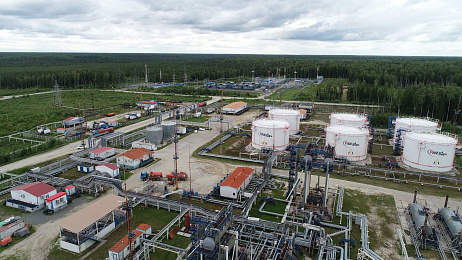
In 2014 RussNeft held 10-th position in the list of top Russian oil companies in terms of oil production. The Company produced 17 mmt of “black gold”, which is 3.2% of the total amount of oil produced in the country (526.7 mmt). The growth comprised 1.5 mmt. For the comparison: the leading company of the industry Rosneft produced 190.9 mmt. RussNeft gas extraction reached 2.3 bcm in 2014 (+50 mln cm). The gas market share of RussNeft is 0.4% (the total gas production for the country amounted 640 bcm, among which 443.9 bcm belongs to Gazprom). Recoverable oil reserves of the Company amounted to 765 mmt, while gas reserves made up 177 bcm. According to the latest figures, RussNeft includes 45 producing enterprises, is developing 167 fields and is being presented in 26 Russian regions, as well as in Azerbaijan and Belarus.