
Gutsriev Cuts a Window to Europe.
Mikhail Gutseriev's RussNeft has found a way to increase its crude oil export. The Company has constructed a railway oil loading terminal not far from Russia’s border with Byelorussia. The terminal transshipment capacity is 5 million thousand tons of crude per year.
Today at the station of Zhecha not far from Russian-Belarusian border RussNeft is opening its new oil-loading terminal, as reported by the Company yesterday. The terminal is designed to transship crude oil from the main pipeline into railway tank-cars to be further delivered to Novopolotsk and Mozyr Refineries of Byelorussia, Baltic States and Eastern Europe, informed a source in the Company. Transshipment by railway will be done by RussNeft-Transport, a company established in March of this year. Its depot numbers 2000 owned and lent tank-cars, which ensures 5 million tons transshipment capacity per year.
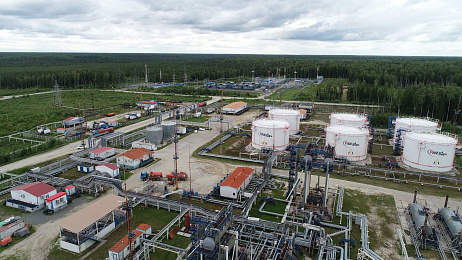
The terminal also includes an oil loading pipe-rack able to fill in 72 tank-cars at a time, a 20-km branch from the main pipeline and 60-thousand-ton total capacity tank farm, as informed by a RussNeft's source. The terminal is designed to transship 5 million tons of crude oil per year to eventually be expanded to 7 million tons. According to a n interlocutor of Vedomosty, it is a 90-million-dollar investment project.
Oleg Kirsanov, an Argus Media oil agency analyst noted that profitability of exporting by railway into Eastern Europe equaled zero therefore no one had ever used this option. He also said that the refineries of Byelorussia received sufficient crude oil volumes by pipeline which was in any case cheaper than railway transportation. The expert assumes that RussNeft is going to take crude oil to the terminal to be subsequently delivered to Baltic ports, Kalinigrad, Ventspills, Klaipeda, Butinge. He also thinks that the Company may become interested to deliver its crude to Mazheikiay Refinery in Lithuania. In any case Yukos used to bring crude oil in there by railway from a similar terminal in Byelorussia’s Rechitsa, the expert recollected.
Kirsanov assumes that the decision to put up the terminal in the same region but on Russia’s territory was pushed up by the intention to increase export possibilities above Transneft quotas, as the deliveries to the new terminal will be looked at as deliveries within Russia.
However Sergey Suverov of Gasprombank indicates that transportation by railway will be profitable with crude oil price ranging 20-25 US dollars per bbl. The expert thinks that a very short distance to Russia’s western border is of great advantage for this project if compared with similar terminals put up by Lukoil in Komi and another one by Rosneft in the north of Russia.
RussNeft was established in September 2002. It is owned by Mikhail Gutseriev and his partners. The Company consolidates 25 small producing enterprises with total reserves exceeding 600 million tons.
A big international trader, Glencore, has been Russneft financial partner in the course of acquiring those equities. Last year RussNeft extracted 10 million tons of crude oil. In the structure of the Company there is a transport enterprise and a retail network with petrol stations in 13 regions of Russia and CIS. The revenue of RussNeft in the nine months of 2004 came up to 4.2 billion rubles.
The terminal also includes an oil loading pipe-rack able to fill in 72 tank-cars at a time, a 20-km branch from the main pipeline and 60-thousand-ton total capacity tank farm, as informed by a RussNeft's source. The terminal is designed to transship 5 million tons of crude oil per year to eventually be expanded to 7 million tons. According to a n interlocutor of Vedomosty, it is a 90-million-dollar investment project.
Oleg Kirsanov, an Argus Media oil agency analyst noted that profitability of exporting by railway into Eastern Europe equaled zero therefore no one had ever used this option. He also said that the refineries of Byelorussia received sufficient crude oil volumes by pipeline which was in any case cheaper than railway transportation. The expert assumes that RussNeft is going to take crude oil to the terminal to be subsequently delivered to Baltic ports, Kalinigrad, Ventspills, Klaipeda, Butinge. He also thinks that the Company may become interested to deliver its crude to Mazheikiay Refinery in Lithuania. In any case Yukos used to bring crude oil in there by railway from a similar terminal in Byelorussia’s Rechitsa, the expert recollected.
Kirsanov assumes that the decision to put up the terminal in the same region but on Russia’s territory was pushed up by the intention to increase export possibilities above Transneft quotas, as the deliveries to the new terminal will be looked at as deliveries within Russia.
However Sergey Suverov of Gasprombank indicates that transportation by railway will be profitable with crude oil price ranging 20-25 US dollars per bbl. The expert thinks that a very short distance to Russia’s western border is of great advantage for this project if compared with similar terminals put up by Lukoil in Komi and another one by Rosneft in the north of Russia.
RussNeft was established in September 2002. It is owned by Mikhail Gutseriev and his partners. The Company consolidates 25 small producing enterprises with total reserves exceeding 600 million tons.
A big international trader, Glencore, has been Russneft financial partner in the course of acquiring those equities. Last year RussNeft extracted 10 million tons of crude oil. In the structure of the Company there is a transport enterprise and a retail network with petrol stations in 13 regions of Russia and CIS. The revenue of RussNeft in the nine months of 2004 came up to 4.2 billion rubles.
More news
All Show allRussNeft increases oil production in the first half of the year by almost 2%
up to 3.043 million tons
International Forum "Russian Energy Week - 2025"
"Russian Energy Week" is the world's leading industry event, bringing together officials, businessmen and experts to discuss the fuel and energy sector development.
RussNeft reported on the planned stocking of rivers in the Khanty-Mansiysk Autonomous Okrug
The company's press service reported on the completion of work to replenish the Ob River basin with fish resources. 1.1 million young nelma and muksun were released.